📚Books
- Introduction to Automata Theory, Languages, and Computation by Jeffrey Ullman and John Hopcrofthttp://ce.sharif.edu/courses/94-95/1/ce414-2/resources/root/Text%20Books/Automata/John%20E.%20Hopcroft,%20Rajeev%20Motwani,%20Jeffrey%20D.%20Ullman-Introduction%20to%20Automata%20Theory,%20Languages,%20and%20Computations-Prentice%20Hall%20(2006).pdf
- Quantum Computing since DemocritusPHYS771 Quantum Computing Since DemocritusPHYS771 Quantum Computing Since Democritus University of Waterloo, Fall 2006 Tuesdays and Thursdays, 1:00-2:30pmBFG Building, 2nd floor seminar room (BFG2125) Instructor: Scott Aaronson 3141 Davis Centre Email: scott at scottaaronson dot com Office hours: After class or by appointment Description: This course tries to connect quantum computing to the wider intellectual world.
https://www.scottaaronson.com/democritus/
 https://www.amazon.com/Gems-Theoretical-Computer-Science-Sch%C3%B6ning/dp/3540644253/ref=sr_1_2?s=books&ie=UTF8&qid=1522242050&sr=1-2&keywords=Gems+of+Theoretical+Computer+Science&dpID=41mn80KPi0L&preST=_SY291_BO1,204,203,200_QL40_&dpSrc=srch
💡Courses
 https://ocw.mit.edu/courses/mathematics/18-404j-theory-of-computation-fall-2006/

✉️Articles
The Physical Origin of Universal Computing | Quanta Magazine
Imagine you're shopping for a new car, and the salesperson says, "Did you know, this car doesn't just drive on the road." "Oh?" you reply. "Yeah, you can also use it to do other things. For instance, it folds up to make a pretty good bicycle.
 https://www.quantamagazine.org/the-physical-origin-of-universal-computing-20151027/
http://www.cs.virginia.edu/~robins/cs6160/slides/Theory_Lecture_16.pdf
P-versus-NP page
This page collects links around papers that try to settle the "P versus NP" question (in either way). Here are some links that explain/discuss this question: For a correct solution of the "P versus NP" question, the Clay Mathematics Institute ( CMI) will award a prize of $1.000.000.
Intro To Information Theory
The Indonesian Caves of Borneo Island offer an insight to the most primitive form of recorded communication. Around some 40,000 years ago, before the evolution of written language, physical illustrations on cave walls were the most precise method of recorded communication.
 https://medium.com/cantors-paradise/intro-to-information-theory-4e3f7d4b5a4b
Who Can Name the Bigger Number?
This essay in Spanish] [This essay in French] [This essay in Chinese] In an old joke, two noblemen vie to name the bigger number. The first, after ruminating for hours, triumphantly announces "Eighty-three!" The second, mightily impressed, replies "You win." A biggest number contest is clearly pointless when the contestants take turns.
https://www.scottaaronson.com/writings/bignumbers.htmlhttps://www.cs.virginia.edu/~robins/The_Limits_of_Quantum_Computers.pdf
🤼 People to follow
- Scott Aaronson
🎁Bonus
CS50's Introduction to Computer Science
This is , Harvard University's introduction to the intellectual enterprises of computer science and the art of programming for majors and non-majors alike, with or without prior programming experience. An entry-level course taught by David J. Malan, teaches students how to think algorithmically and solve problems efficiently.
https://www.edx.org/course/cs50s-introduction-to-computer-science
Introduction to Computer Science and Programming Using Python
This course is the first of a two-course sequence: Introduction to Computer Science and Programming Using Python, and Introduction to Computational Thinking and Data Science.
https://www.edx.org/course/introduction-to-computer-science-and-programming-7

Build a Modern Computer from First Principles: From Nand to Tetris (Project-Centered Course)
Offered by Hebrew University of Jerusalem. What you'll achieve: In this project-centered course* you will build a modern computer system, from the ground up. We'll divide this fascinating journey into six hands-on projects that will take you from constructing elementary logic gates all the way through creating a fully functioning general purpose computer.
 https://www.coursera.org/learn/build-a-computer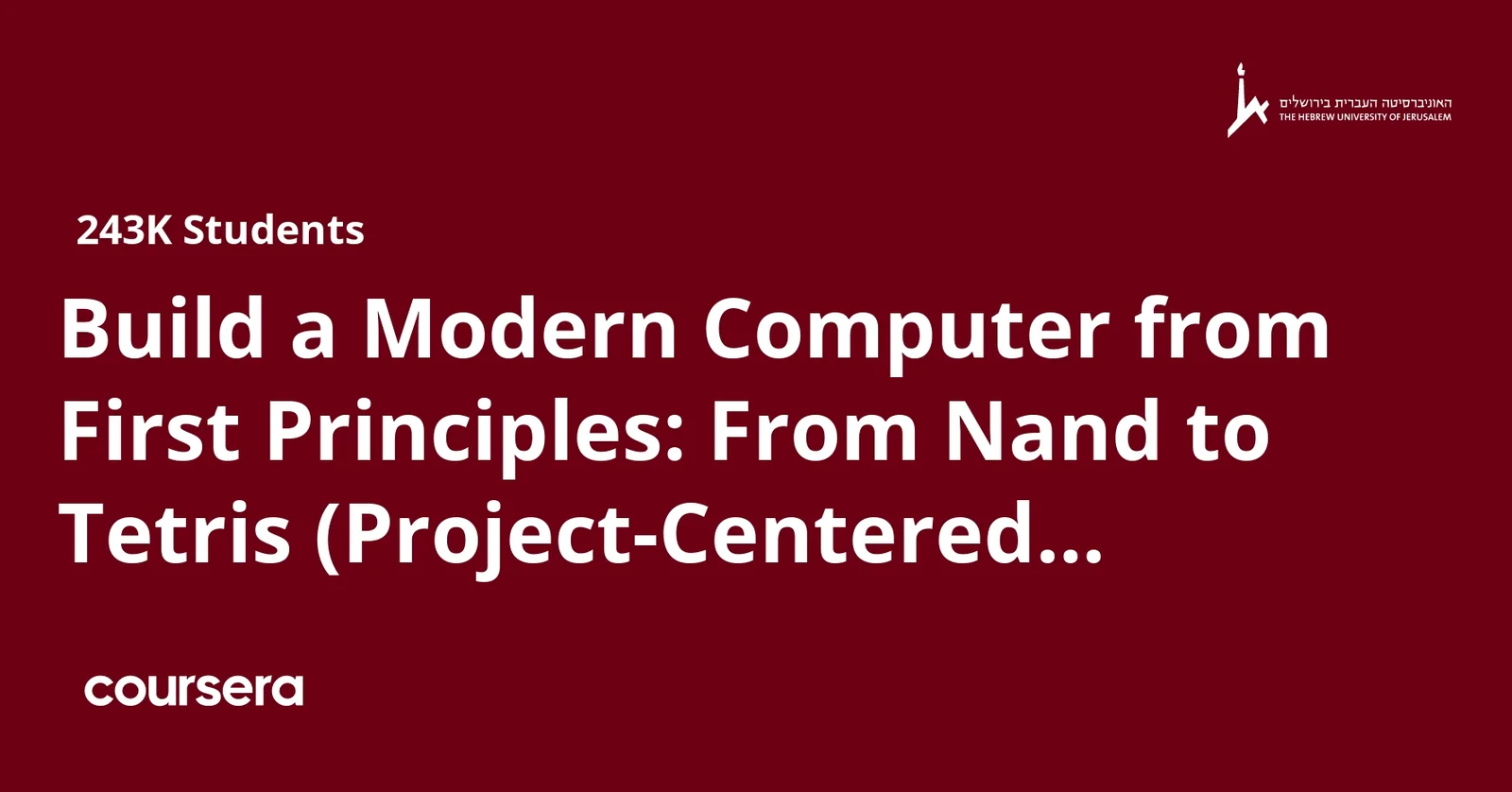
Shtetl-Optimized
June 11th, 2020 Will He Go?, by legal scholar Lawrence Douglas, is, at 120 pages, a slim volume focused on a single question: what happens if the 2020 US election delivers a narrow or disputed result favoring Biden, and Trump refuses to concede?
https://www.scottaaronson.com/blog/